
Dummy Hoy Day: The Deaf Pioneer Who Gave Baseball Its Voice
On May 23, a free event at The Banks will honor a man born in rural Ohio who lost his hearing at age three, graduated as his school's valedictorian, became a professional baseball player despite widespread rejection, put together one of the most statistically impressive outfield careers of the 19th century, and left fingerprints on every Major League Baseball game played for the last 120 years. William "Dummy" Hoy turns 164 this year, and Cincinnati is finally throwing him the kind of party his legacy deserves.
Dummy Hoy Day runs from 5 to 7 p.m. ahead of the Reds vs. Cardinals game, free and open to the public. Led by Deafinitely For All Entertainment, a Deaf-founded production company, the event features interactive storytelling, ASL integration throughout the programming, birthday cookies, Reds mascot appearances, and Deaf advocacy organizations from across the region. Marty Brennaman will be on hand to speak to Hoy's place in baseball history. It is the kind of occasion that the city of Cincinnati should have been holding for decades, and the fact that it is happening now is worth celebrating for anyone who loves the game.
Let's Start With the Stats, Because They're Ridiculous
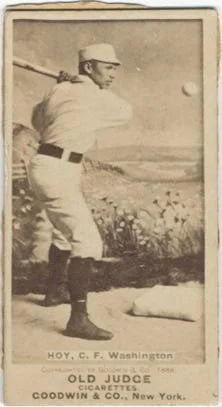
Hoy contracted meningitis at age three during the final year of the Civil War and was left permanently deaf and mute. He grew up in Houcktown, Ohio, a farming hamlet, and attended the Ohio School for the Deaf in Columbus, graduating valedictorian in 1879. His family assumed he would cobble shoes for the rest of his life. He spent his weekends throwing a baseball at a chalked X on a barn wall.
By 1888, he was a Major League Baseball player for the Washington Nationals. By the time he retired in 1902, he had accumulated 2,048 hits, 596 stolen bases, 1,429 runs scored, a .386 career on-base percentage, and a collection of defensive records that stood for years. He held the Major League record for games played in center field from 1889 to 1920. On June 19, 1889, he threw out three runners at home plate in a single game from center field. The record has been tied twice since. Nobody has broken it.
His teammates included Honus Wagner, Connie Mack, Rube Waddell, and Fred Clarke. His manager Charlie Comiskey valued him so highly that he recruited Hoy to three different franchises across three different leagues. Sam Crawford, a Hall of Famer who played alongside Hoy with the Reds in 1902, called him "a fine outfielder, a great one" and later argued publicly that Hoy deserved a place in Cooperstown. Crawford is there. Hoy is not.
Every Time an Umpire Signals a Strike, That's Hoy
Here is where the story gets genuinely fascinating. Every time a home plate umpire punches a strikeout call, extends his arm wide on a safe call, or signals a ball with a leftward thrust of the hand, those gestures trace a direct line back to accommodations developed for Dummy Hoy.
When Hoy first arrived in professional baseball, umpires only shouted their calls. Hoy could not hear them. In his first professional season, opposing pitchers learned to quick-pitch him in the time it took him to turn and read the umpire's lips, driving his batting average to a career-low .219. The solution was practical and elegant: his third-base coach began using hand signals to relay the count. His batting average jumped to .367 the following year.
That system traveled with him from Oshkosh to Washington to St. Louis to Cincinnati to Chicago. In 1906, years after Hoy's final Major League game, umpire Silk O'Loughlin lost his voice before a World Series game. The Washington Post reported that he turned to what reporters immediately recognized as "Dummy Hoy's mute signal code." O'Loughlin found the system so effective against crowd noise that he kept using it throughout the Series. By 1908, the raised right hand for a strike had taken hold as standard practice across the league.
Some historians have pushed back on Hoy's direct credit, noting that standardized gestures did not become universal until after his retirement. The debate is real and worth engaging. But even the skeptical version of the story leaves something remarkable standing: reporters in 1906 had a name already attached to those signals. They called them Hoy's. The Deaf community knew the story and held it for decades before mainstream baseball history caught up. As historian Rebecca Edwards wrote in her research on the subject, "Deaf fans knew it all along. Hearing fans just weren't listening."
The Crowd Couldn't Clap for Him, So They Waved
One of the most quietly moving details of Hoy's career is what happened when he made a brilliant play. Crowds around the league gradually understood that applause was useless to a man who could not hear it. So they waved. Hats off, arms in the air, thousands of hands moving in appreciation of what they had just witnessed. The Deaf community calls this visual applause. In the 1880s and 1890s, baseball crowds stumbled into it on their own, because a small, fast center fielder from Ohio had given them no other choice.
Sporting Life reporter Henry Furness described it in 1892: when Hoy made a brilliant catch, the crowd arose en masse and wildly waved hats and arms. It was the only way in which they could testify their appreciation to the deaf-mute athlete.
That image, tens of thousands of people learning a new language to honor one player, sits at the center of what Dummy Hoy's career actually means. His presence in the game produced adaptation. It produced empathy. It produced a new way of communicating on a baseball field that the sport still uses today.
Cincinnati Has Always Been His City
The Reds are the oldest professional baseball franchise in the country. The city has Opening Day wired into its civic identity the way other cities organize around football or basketball. Hoy played his longest stretch with Cincinnati, five seasons across two stints, hitting .293 with a .392 on-base percentage in a Reds uniform. He threw out the first pitch of Game 3 of the 1961 World Series at Crosley Field at the age of 99, and the crowd gave him a standing ovation. His ashes were scattered at Lytle Park. Cincinnati was his home field long after the last game was played.
Get Down to The Banks on May 23
The argument for Dummy Hoy's place in the National Baseball Hall of Fame has been active since at least 1991, pushed forward by the USA Deaf Sports Federation, baseball historians, and advocates who understand that the Hall's own criteria covers "ability, integrity, sportsmanship, character and contribution to the game." Hoy qualifies on every count. He was inducted into the Reds Hall of Fame in 2003, named SABR's Overlooked 19th Century Baseball Legend in 2018, and honored at Gallaudet University with a field bearing his name. Cooperstown still has not called.
Until it does, Dummy Hoy Day at The Banks is the right kind of recognition: local, personal, and rooted in the community where Hoy spent the final decades of his life. Deafinitely For All Entertainment and the event's Deaf advocacy partners are putting something together that is bigger than a birthday celebration. They are making the case, in real time, that this story belongs to everyone who has ever watched an umpire call a strike.
Go to The Banks on May 23. Bring your kids. Learn a little ASL. Eat the complimentary cookies. And the next time an umpire punches the air behind home plate, think about a cobbler from Houcktown, Ohio, whose presence in the game made that gesture part of baseball forever.