
A Living Story at Cincinnati’s Freedom Center
February has a way of asking bigger questions. What do we carry forward. What do we protect. What do we pass down. In Cincinnati, the National Underground Railroad Freedom Center is answering with a Black History Month lineup that treats history as a living practice shaped by scholarship, art, film, and the everyday work of keeping memory intact.
Across five programs in February 2026, the Freedom Center is inviting the public into a month that feels expansive, participatory, and rooted in community. All programs are included with museum admission and open to the public, with pre-registration recommended.
February 2026 also lands on a meaningful national marker. The tradition traces back 100 years to 1926, when Dr. Carter G. Woodson launched Negro History Week after years of pushing the country to study Black life with rigor and respect. The observance grew over decades, formally expanding to Black History Month in 1976, and continues today as a time to research, preserve, interpret, and celebrate Black life, history, and culture. For a clear overview of those origins, see the Association for the Study of African American Life and History at asalh.org.
Shawnee Turner, the Freedom Center’s Vice President of Education and Interpretation, frames the month with a line that sets the tone for the entire series. Black history is a living story that we continue to uncover and honor every day. That is the point of this February lineup. The month is an invitation to keep learning, keep asking, and keep connecting history to the present.
The programming is also built through partnership, which matters. The Freedom Center developed elements of the lineup alongside organizations including Elementz and the Attucks-Lee Banneker Chapter of the Daughters of the American Revolution, linking national scholarship with Cincinnati’s local cultural engine.
A Month Built for Different Lenses, Not One Script
There is a quiet mistake people make when they talk about Black History Month. They treat it as a single genre. A lecture series. A school unit. A poster set. The Freedom Center’s February calendar rejects that narrow framing. It is built like a playlist, with different modes that reach different audiences, and together they form a fuller picture.
Christian Casas, Manager of Performance and Time-based Programs, puts language to the strategy. The goal is to make Black history accessible through different lenses and expressed through different mediums. That is not a buzzword. It is a practical approach to public history. People arrive with different entry points, and a museum that wants to serve its city builds multiple doors.
The Anchor Moment: Fifth Third Community Day
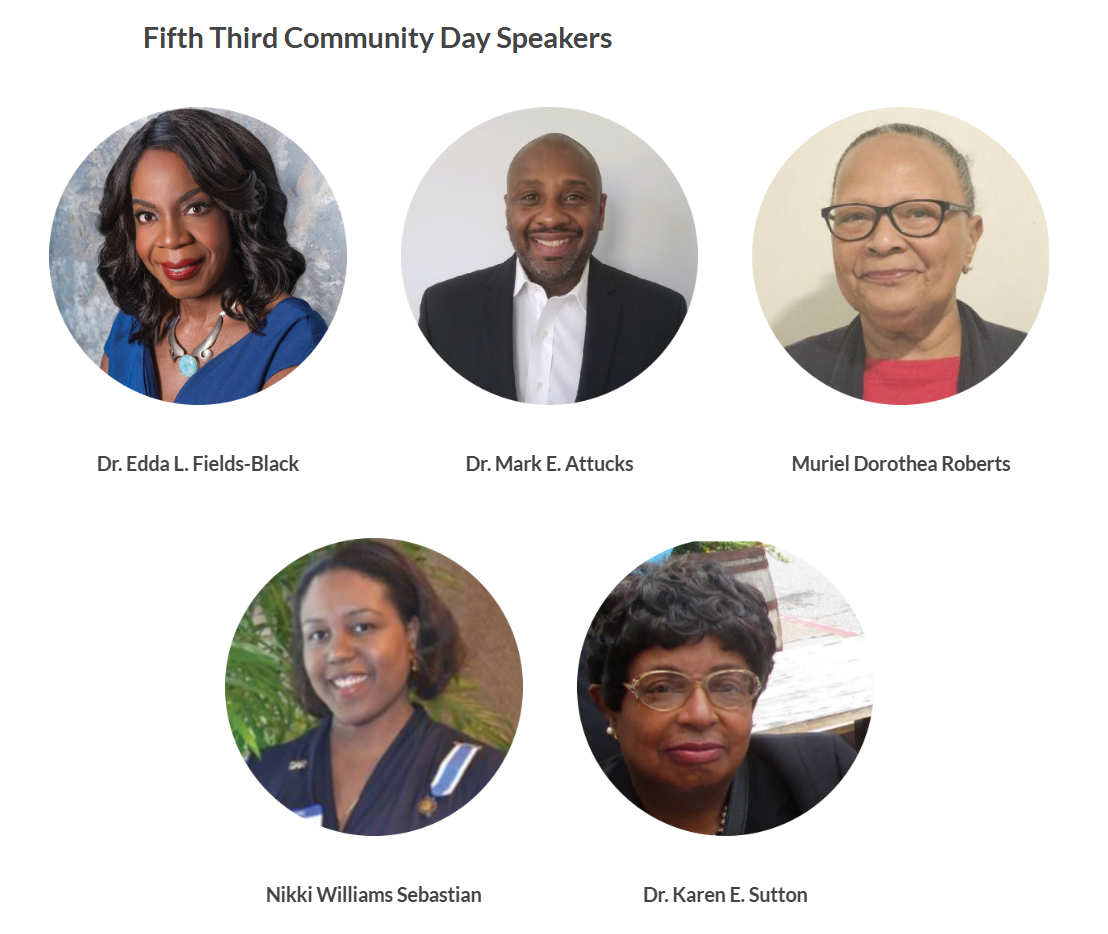
If you want one day that captures the entire spirit of the month, it is Fifth Third Community Day on February 15, when museum admission is free thanks to the Fifth Third Foundation. The Freedom Center turns the day into a concentrated slate of scholarship and storytelling, with speakers who work across periods and methods.
The marquee event is a lecture and book signing with Pulitzer Prize winning historian Dr. Edda L. Fields-Black, whose work centers on Harriet Tubman and the Combahee River Raid. Tubman’s story often circulates in public memory as an icon, and she is an icon, but serious history brings the full dimensions into focus: strategy, coalition, risk, leadership, and the long arc of Black freedom efforts during the Civil War. This kind of scholarship gives the public something more valuable than inspiration. It gives context.
Fields-Black is joined by fellow historians, scholars, and authors Dr. Karen Sutton, Dr. Mark Attucks, Muriel Roberts, and Nikki Williams Sebastian. Taken together, that roster signals range. Black history lives in the Revolutionary era, in the Civil War era, and in the family records and oral histories that communities fight to keep intact. This speaker slate turns the museum into an active forum, the kind that makes visitors feel like participants in the work of remembering.
Film as Black History’s Visual Archive
One of the smartest choices in the Freedom Center’s lineup is the decision to center Black cinema as a historical medium, not a side attraction. The programming highlights the L.A. Rebellion, the influential group of filmmakers associated with UCLA who reshaped independent Black film, screening the documentary Spirits of Rebellion along with curated short films.
Film matters here because it preserves the emotional truth that textbooks rarely capture. It documents community life. It carries accents, neighborhoods, intimacy, and political pressure in ways that a timeline cannot. The conversation component, guided by University of Cincinnati film professor Dr. Mary Leonard, gives viewers a framework for understanding why these films were made and what they changed.
Performance as Proof of the Present
History needs art because art is one of the ways history survives. The Unbound Voices talent showcase brings spoken word, music, and dance into the Harriet Tubman Theater, featuring poets Desirae Hosley, Isabella Gordo, and Zinnia Stewart, along with Wordplay, (CA)^2 Dance Crew, and Cincinnati Jazz Academy.
This matters because it draws a clear line between memory and motion. Performance is not a break from history. Performance is one of the ways communities hold history in public, especially when other systems have tried to silence it. A Freedom Center stage that belongs to local artists is an argument about where Black history lives. It lives here, right now.
The Program That Changes What People Believe They Can Keep
The most quietly radical offering in the lineup is the interactive workshop on preserving family history. It meets visitors at the point where history becomes personal, where the “big story” becomes your story, your family’s story, your photos, your letters, your documents, your names.
In a country where Black family histories have often been disrupted by violence, displacement, and institutional neglect, preservation is more than a hobby. It is protection. It is continuity. A workshop that teaches people how to care for family artifacts expands who gets to be an archivist and who gets to participate in the historical record.
Cincinnati Speaks Through Hip Hop
The month closes with a program that grounds Black history in local culture and current reality: a screening of Or Does It Explode?, a documentary produced by Elementz that uses hip hop to explore Cincinnati’s past, present, and future while confronting social justice issues. The post-screening conversation features Damian Hoskins of Elementz Hip Hop Cultural Art Center and Camille Jones.
This is where Black History Month stops feeling abstract. It becomes about neighborhoods, pressures, creativity, and how a city tells the truth about itself. Hip hop is a language of record, and a museum that makes space for it is making a clear choice about what counts as history.
Why This Works and Why It Matters
The Freedom Center’s February lineup is strong because it is built for real people. Visitors who want scholarship get scholarship. Visitors who want film get film. Visitors who want performance get performance. Visitors who want tools to protect their own history get a workshop with materials and guidance.
This is also what it looks like when a museum treats Black History Month as a civic responsibility rather than a seasonal theme. The programming widens access through museum admission inclusion, and Fifth Third Community Day expands access further with free admission. It invites Cincinnati into the building, then turns around and asks Cincinnati to bring its own stories with it.
For tickets, pre-registration, and the full calendar, start at freedomcenter.org.