
Two Arms and Zero Chill
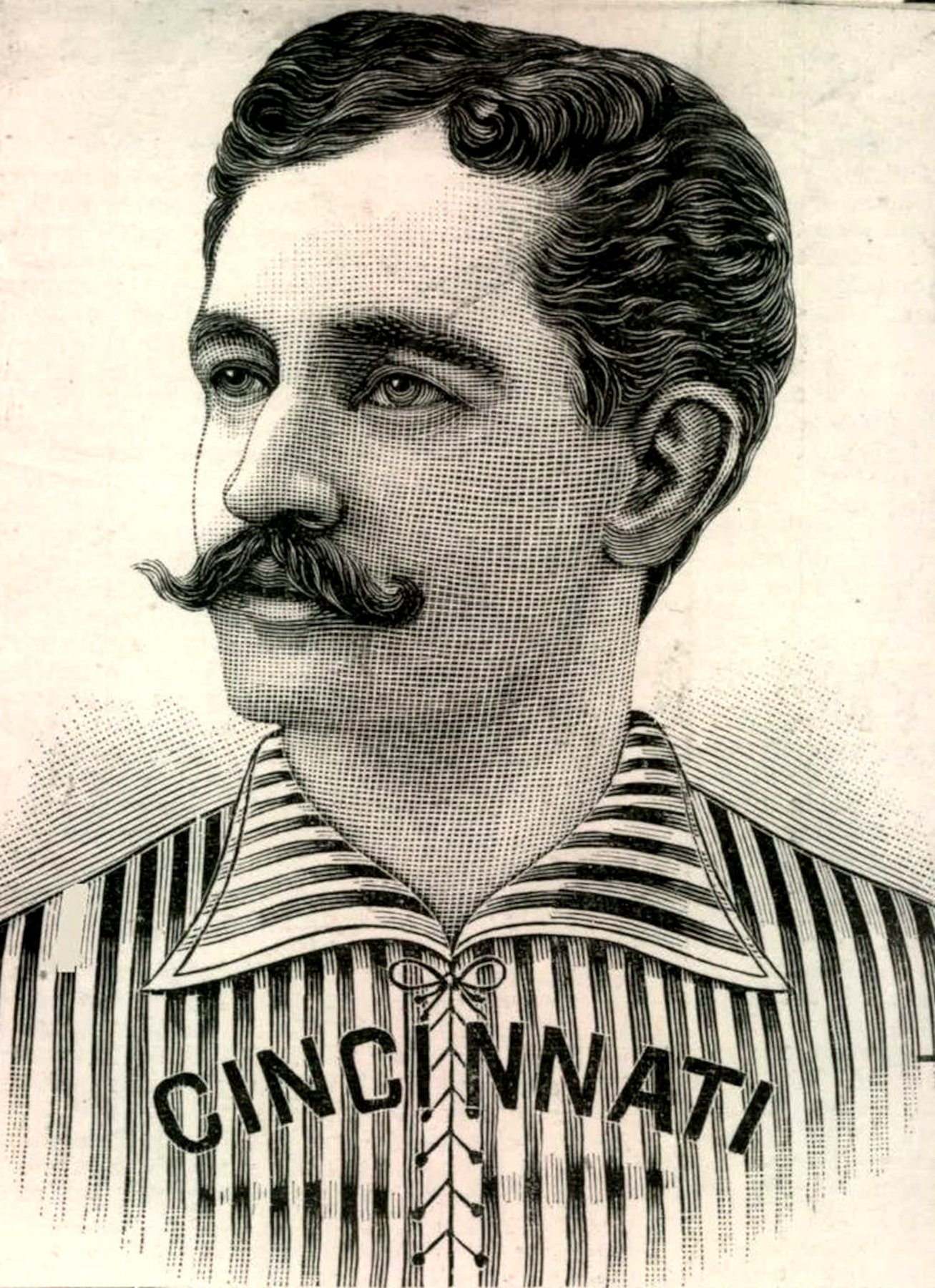
Recently Cincinnati Magazine posted a story on Tony Mullane. Custom-built for a modern sports cycle. Tony had the arm talent, the face, the ego, the nicknames, the volatility, and the sort of résumé that makes baseball historians lean forward and casual fans ask why they have not heard more about him. Cincinnati knew him as “Apollo of the Box.” Baseball history remembers him as an ambidextrous marvel, a workhorse ace, a record-holder for wild pitches, and one of the best pitchers outside Cooperstown. The 2026 version of that profile would light up highlights, podcasts, debate shows, and every corner of baseball social media.
Mullane’s numbers still carry real force. His career totals sit at 284 wins, 220 losses, a 3.05 ERA, and 1,803 strikeouts over 13 major league seasons. He threw a no-hitter on September 11, 1882, led the American Association in strikeouts in 1882, and led the league in shutouts twice. He also remains the major league career leader in wild pitches with 343, which is a statistic that doubles as biography. It tells you he was electric and disorderly in the same breath.
That is why Mullane still feels alive as a subject. The numbers say ace. The stories say headache. The image says star. Put those pieces together and you have a player who fits neatly into modern baseball conversation, even though he played his last big league game in 1894. But the question I have is, would Tony thrive in today’s MLB?
The Stats Translate Better Than You Might Think
The surface challenge in comparing Mullane to modern pitchers is workload. Nineteenth-century starters carried absurd inning totals and piled up win counts that no current ace can chase. The smarter comparison is not raw volume. It is role, status, and quality.
In that frame, Mullane reads like a frontline modern ace. Baseball-Reference and Wikipedia anchor him as a top-of-rotation figure with high-end durability for his time and enough dominance to sit among the winningest pitchers in history. Wikipedia notes that his 284 wins tie Ferguson Jenkins for 27th all time and place him fourth among eligible pitchers not in the Hall of Fame. That is not trivia. That is upper-shelf company.
The closest modern statistical comparison in stature is Max Scherzer. Scherzer’s current career line through the 2025 season stands at 221 wins, a 3.22 ERA, and 3,489 strikeouts, along with three Cy Young Awards and two no-hitters. The styles are not identical, but the broad category fits. Mullane was the sort of pitcher who would enter a season today with ace billing, national attention, and a case to be framed as one of the game’s marquee starters. Scherzer occupies that same air.
The texture of Mullane’s profile adds another name. Carlos Rodón is useful as a volatility comp. A Yankees Magazine profile from MLB described Rodón as “a fiery, intense competitor” who has worked to control his emotions. Mullane’s record of brilliance mixed with wildness makes that comparison feel right. His game had force and turbulence. The career wild-pitch record confirms that the turbulence was not a side note. It was part of the package.
So the modern shorthand is clear enough: Mullane had Scherzer-level ace gravity with a Rodón streak of on-field volatility.
The Personality Belongs in the Age of Branding
The public-facing Mullane feels less like Scherzer and more like Bryce Harper if Harper had spent his career on the mound.
Mullane was known as “The Count” and “Apollo of the Box,” which tells you plenty before a single pitch is thrown. Those are not nicknames you give a modest craftsman. Those are stage names for a baseball celebrity who knew the camera would find him if cameras had existed. Cincinnati Magazine leaned into that angle, and the historical record supports it. Mullane was handsome, marketable, proud of it, and fully aware of his own draw.
That trait would fit smoothly in today’s MLB. The league openly invites players to show more of themselves. MLB’s 2025 Players’ Weekend rollout described the event as “a chance for players to be themselves, showcase their personalities or help their favorite charities,” and said those stories would be amplified through broadcasts, stadium presentation, and social media. In modern league language, Mullane’s vanity would be recast as brand identity. His flair would become content strategy. His nickname would be on merch by Memorial Day.
He would be a producer’s dream. He could pitch with either hand. He had old-school ace credentials. He looked like he expected applause when entering a room. You can already hear the panel segment titles and sponsor copy.
The Ambidextrous Trick Would Become a Full-Time Spectacle
Mullane’s most famous novelty remains one of the weirdest and coolest items in baseball history. He could throw with either hand, and Wikipedia credits him as the first pitcher to throw left-handed and right-handed in the same game. He developed that skill after an injury to his right arm, learned to throw left-handed, then kept both options once his right arm healed. Because he pitched in the pre-glove era, the switch was even easier to deploy.
That skill would be irresistible today. Every matchup would become a production meeting. Every plate appearance against a switch-hitter would trigger rules discussion, graphic packages, and replay angles. The modern game loves rare physical traits because they scale beautifully across television, streaming clips, and betting conversation. Mullane’s ambidexterity would be one of the sport’s biggest recurring attractions.
He would also live in the lab. Pitch design departments would treat him like a government project. Imagine what a modern player development staff would do with a pitcher who could potentially shape different arsenals from both sides. That thought alone makes Mullane feel like a baseball Rorschach test for the current era.
Could Today’s MLB Actually Handle Him?
Parts of Tony Mullane would thrive in today’s major leagues. His talent would play. His charisma would play. His appetite for attention would play. MLB has room for stars with heat, edge, ego, and a little theater.
The full historical version of Mullane would hit a wall.
The league environment is far more regulated and far more visible than the world he inhabited. MLB’s player resource center lays out formal conduct policies and a much more structured professional environment than nineteenth-century baseball ever had. The media ecosystem is also harsher and faster. A quote from a century ago can now become a daylong firestorm in ten minutes.
And that brings us to the part of Mullane’s record that cannot be brushed aside with a wink and a sepia filter. In 1884, he was paired in Toledo with Moses Fleetwood Walker, one of the first Black players in major league history. Mullane later said Walker was “the best catcher I ever worked with,” while also admitting that he disliked pitching to a Black catcher and ignored Walker’s signals. Wikipedia directly connects that behavior to Mullane’s league-leading 63 wild pitches that season. This belongs in any honest account of who he was.
A player carrying that same documented conduct into modern MLB would face severe consequences in reputation, endorsement value, clubhouse standing, and league scrutiny. MLB annually marks Jackie Robinson Day across all 30 clubs, with every player wearing No. 42 and league-wide programming centered on Robinson’s legacy and impact. That is the current moral and cultural framework of the sport. Mullane’s ugliest documented behavior would crash directly into it.
So the answer to the modern-Mullane question is nuanced and pretty sharp around the edges. The swagger works. The ambidextrous showmanship works. The ace credentials absolutely work. The racism detonates the whole package.
Cincinnati Still Has Claim to Him
Mullane matters in Cincinnati because this city has always appreciated sports figures with a little voltage leaking out of the seams. He pitched for the Cincinnati Red Stockings and Reds from 1886 through 1893, won 163 games there, and later earned induction into the Cincinnati Reds Hall of Fame in 2010. That is not a decorative local tie. Cincinnati was one of the central stages of his career.
He also fits a familiar Cincinnati sports archetype: the gifted original, the performer with enough brilliance to draw loyalty and enough mess to keep the story alive. Mullane gave the city an early baseball star who could dominate a game, derail a frame, charm a crowd, irritate authority, and leave behind arguments that still feel fresh.
That is why he remains such a rich subject for a modern sports magazine. Tony Mullane was a stat monster with a carnival edge. He was a baseball celebrity before MLB had a branding department. He was a dazzling athlete with a historical record that demands honesty. He belongs in any serious discussion of the game’s earliest stars, and he would absolutely own a week of baseball discourse in 2026.