
Career built on Timing
Via Cincinnati Reds
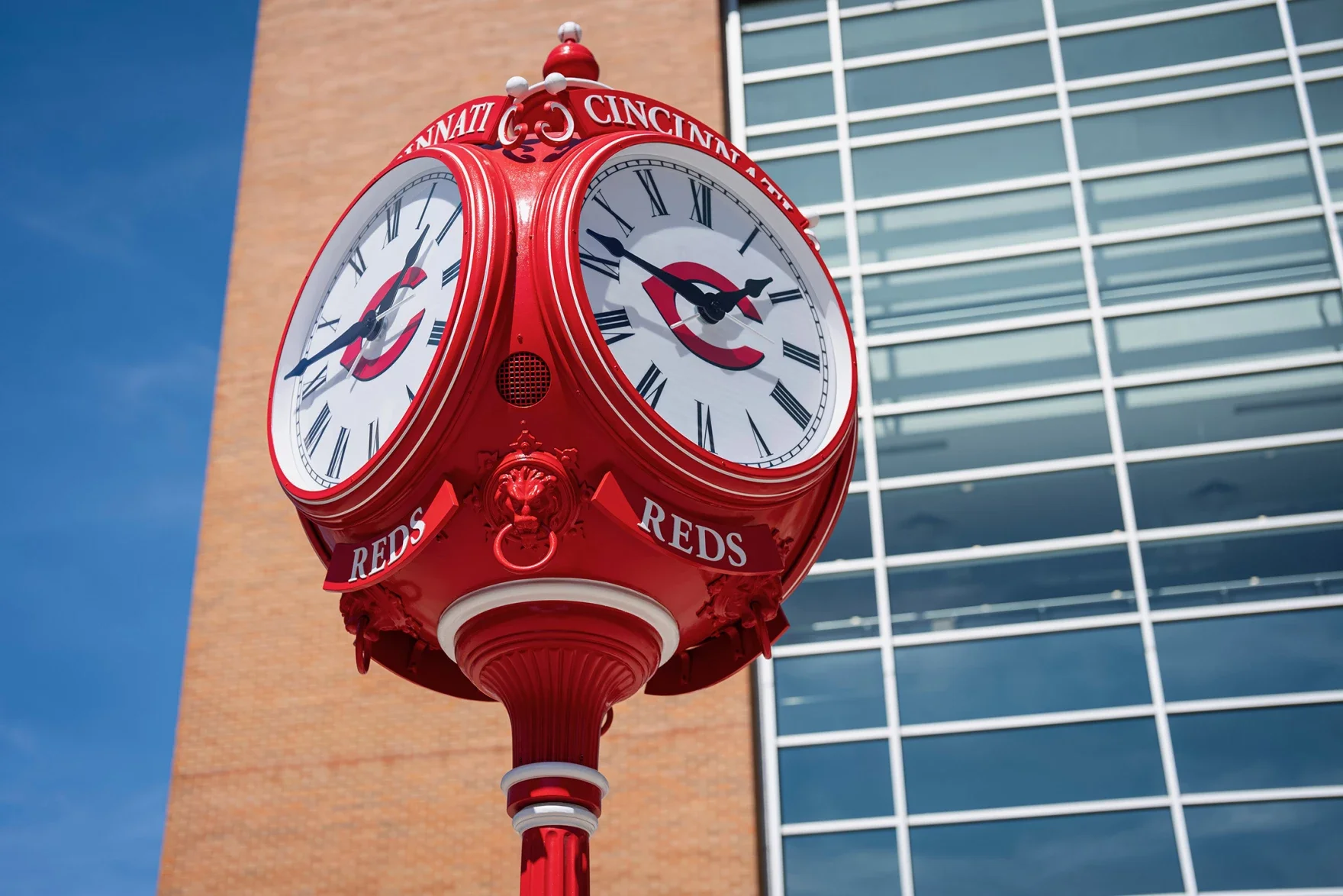
Just in time for Opening Day. Joey Votto’s custom Verdin clock outside Great American Ball Park belongs in the second category. It stands on Crosley Terrace at the main entrance to the park, 16 feet 8 inches tall, with four 36-inch dials and a bronze plaque that reads, “Thank you Cincinnati.” It is large, elegant, old-world, and unmistakably theatrical. It feels exactly right for a player who spent 17 major league seasons turning the smallest moments in an at-bat into something unforgettable.
The clock matters because Joey Votto mattered in a way that went beyond box scores, even though the box scores are dazzling on their own. He gave Cincinnati a landmark because he already gave the Reds a baseball life rich with precision, patience, production, and personality. The gift is permanent. So is the legacy.
A Gift With Cincinnati Character
The details of the clock make the whole thing sing. It was built by the Verdin Company, a Cincinnati institution, and placed in one of the highest-traffic spaces in the city’s baseball orbit. Votto said he wanted it to add “charm and mystique” to the Reds experience and hoped it would become part of future memories at the ballpark. That is a beautifully Votto sentiment. He was always a little more literary than the average slugger, a little more reflective than the average star, and fully aware that baseball is a sport built on ritual, place, and returning.
This is why the gift lands so well. A statue would have felt expected. A plaque would have felt ceremonial. A clock feels alive. Fans will pass it on Opening Day. Kids will point at it. Friends will use it as a meeting spot. Photos will pile up around it. It will become part of the traffic pattern of Reds baseball, which is another way of saying it will become part of the memory pattern of Cincinnati.
That is the essence of a meaningful sports legacy. It lives in the numbers, yes, but it also lives in the geography.
The Numbers Are Heavyweight Numbers
Votto’s career résumé has real thunder.
According to Baseball-Reference, he finished with 2,135 hits, 356 home runs, 1,144 RBI, a .294 batting average, a .409 on-base percentage, a .511 slugging percentage, a .920 OPS, a 144 OPS+, and 63.6 WAR. That is elite production by any serious historical standard. The .409 OBP is the kind of figure that forces you to stop and recalibrate. It places Votto in rare air among modern hitters and reflects the skill that defined him better than any single highlight ever could.
His official MLB résumé adds the hardware: six All-Star selections, the 2010 National League MVP, the 2011 Gold Glove at first base, and the 2010 NL Hank Aaron Award. Those honors map cleanly onto the player Cincinnati watched for nearly two decades. He was not a compiler drifting through long seasons. He was a centerpiece. He was an annual problem for opposing pitchers. He was a hitter who could take over a game with a walk, a line drive, or a home run, sometimes all in the same series.
The advanced metrics tell you why modern baseball people revere him. A 144 OPS+ means Votto created offense 44 percent better than league average over his career. That is superstar territory. A 63.6 WAR career places him in the band where Cooperstown debates tend to become celebration rather than argument. MLB’s own Hall of Fame roundtables have treated his case with striking confidence, including one 2024 discussion where the position was direct: Votto is a Hall of Famer.
The Reds Version of Greatness
Some careers are famous. Some are franchise-defining. Votto’s was the second kind.
He spent his entire 17-year major league career with the Reds, debuting in 2007 and remaining the central figure of the franchise through 2023. In an era of movement, churn, and transactional roster building, that kind of permanence carries huge emotional weight. Fans did not borrow Joey Votto from baseball history for a few elite years. Cincinnati got the whole story.
That continuity matters when you place him in the Reds’ lineage. Cincinnati has one of the richest baseball histories on earth, which means franchise immortality is expensive real estate. Votto still forced his way into that conversation. Baseball-Reference’s Reds hitting leaderboards place him among the most valuable position players in franchise history by WAR, which is where serious legacy talk begins. He belongs in the company of the names that shape the building.
His legacy also sits in a very specific baseball lane that made him singular. Votto was a superstar first baseman who treated the strike zone like a chessboard. He made patience entertaining. He made stubbornness look elegant. Pitchers could not rush him, fool him often enough, or keep him from reaching base for very long. In a sport that often celebrates violence, Votto built greatness through control. Fans who watched him every day came to understand that a seven-pitch walk could feel as decisive as a missile into the seats.
That style shaped his identity in Cincinnati. He was brilliant, eccentric, funny, self-aware, and deeply committed to the craft of hitting. He gave the Reds star power, but he also gave them texture.
The perfect gift
The symbolism of the clock is almost too good.
Votto’s gift is about time, and his career was about mastering it. He controlled pace in the batter’s box. He lengthened innings. He exhausted pitchers. He bent the rhythm of games toward himself. Now he has placed a clock outside the ballpark as a permanent thank-you to the city where he spent his baseball life. The gesture carries warmth, humor, and intelligence. It feels handpicked by a player who understood that legacy should have shape and setting.
WVXU’s framing of the story captured that elegantly by tying the clock to Votto’s “time” in Cincinnati. The pun works because the truth underneath it is strong. He gave the Reds years of excellence and gave the city a physical object that will keep time with future generations of fans.
There is also a local pride angle here that makes the whole story richer. Votto chose a Cincinnati company to build it. He placed it at the front door of Cincinnati baseball. He signed the thank-you message himself. Every part of the gesture feels rooted in place. This is how sports figures become civic figures. They stop belonging only to highlight reels and start belonging to the city’s visual language.
The Legacy Is Secure
Joey Votto’s legacy as a Reds player is secure because it has depth in every direction.
He has the career totals. He has the awards. He has the peak. He has the longevity. He has the one-franchise identity. He has the reverence of analysts who understand how rare his offensive profile was. He has the affection of fans who lived through his prime. He has the signature moments, the national recognition, the statistical case, and now a literal landmark outside the ballpark.
What remains is the long formal process of baseball remembrance. Hall of Fame debates will keep coming, though the case is already powerful. Cincinnati will continue the natural conversation about permanent franchise honors. The fans, meanwhile, have already done what fans always do when they know they have witnessed something rare. They have folded Votto into the permanent story of the place.
That is why the clock works so well. It is useful, beautiful, public, and impossible to miss. Much like Joey Votto at his best.
He gave Cincinnati a thank-you gift that looks like it belongs outside a cathedral of baseball. Given the career he built here, that feels exactly appropriate.