Glow Big or Go Home
There is a question that every city eventually has to answer for itself. The question has nothing to do with infrastructure or tax incentives or skyline square footage. It asks something older and harder: what do you believe your people deserve?
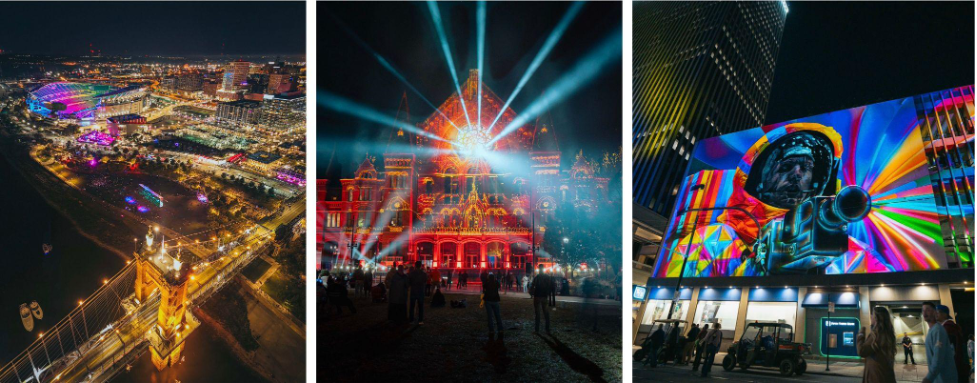
Cincinnati has been answering that question since 2017 with paint, light, projection, and the kind of collective will that makes outsiders stop scrolling and start buying plane tickets. BLINK, the country's largest celebration of public art and light, returns October 8 through 11, 2026, and with it comes the fifth edition of something that has quietly grown into one of the most significant cultural statements any American city makes on a biennial basis.
Ninety-plus artists. More than sixty downtown city blocks. Fifteen nations represented among past attendees. Two million people who showed up in 2024 and found something they were not entirely sure they were looking for. A $205 million economic impact rippling through hotels, restaurants, rideshares, and the kind of neighborhood businesses that do not show up in quarterly earnings reports but keep a city breathing.
A Free Festival For All
BLINK has always been free. Walk in off the street, look up, and let it land on you. That choice, made deliberately and protected across five editions, carries a philosophical weight that deserves to be named.
When a city decides that world-class art belongs to everyone who shows up rather than everyone who can afford a ticket, it is making a statement about who counts as a citizen of culture. That statement has consequences. It draws the grandmother and the graduate student to the same corner of Over-the-Rhine. It puts a kid from Covington and a tourism executive from Berlin in front of the same wall at the same hour. Public art at this scale becomes the only kind of shared experience that a fractured, screen-addicted, algorithm-sorted society almost never produces anymore: genuine, unrepeatable, democratic surprise.
BLINK's 2026 roster deepens that democratic impulse in a specific and meaningful way. The press release notes a record number of women artists and a significant surge of first-time participants. Artists from France, Hungary, Romania, Switzerland, Brazil, Argentina, Greece, South Africa, Sweden, Thailand, and Australia are making the trip. Alongside them: students from Xavier University, the Art Academy of Cincinnati, Miami University, the University of Cincinnati's College-Conservatory of Music, Columbus College of Art and Design, and Northern Kentucky University. Emerging and established, global and local, projected and painted, interactive and still.
The curatorial philosophy embedded in that list is worth reading twice. BLINK has always been committed to showcasing emerging artists alongside those who exhibit at major international institutions. That commitment means a 22-year-old with a compelling idea gets the same city blocks as someone who has shown in Paris. That is a radical act dressed up as a light festival.
opening Night Has Grown Into Something Bigger
For years, BLINK opened with a parade. In 2026, the tradition evolves into Ready. Set. BLINK!, a five-block activation surrounding TQL Stadium running from 4 to 9 p.m. on October 8. Live music from local DJs and performers, hands-on light art creation stations, interactive installations, and food and beverage vendors will fill the footprint before the sun goes down.
Then, at sundown, Cincinnati collectively turns the lights on.
A drone and pyrotechnic show will illuminate the stadium and surrounding skyline, launching four days of immersive experience across the urban core. First Financial Bank is sponsoring the "Turn On the Lights" contest, a region-wide engagement campaign designed to give communities across the tristate a role in that opening moment.
The gesture carries more meaning than it might first appear. A city turning its lights on together, literally, is an image worth sitting with. After years of national division, cultural withdrawal, and a creeping public suspicion that shared civic life might be finished, that image answers something.
Art as Economic Infrastructure
The skeptics, those who believe public investment in culture is a luxury expenditure better redirected toward roads or budgets, have a data problem.
A 2024 analysis by the Center for Research and Data within the Cincinnati USA Regional Chamber found that the 2022 edition of BLINK produced a $249 million total economic output and generated $6.8 million in income, sales, and hotel tax revenue for state and local jurisdictions. The 2024 iteration is estimated to have delivered $205 million in direct economic impact. Approximately 19 percent of BLINK visitors in 2024 came from outside the Cincinnati region, nearly double the out-of-region attendance from 2022, and representatives of fifteen countries were in the crowd.
ArtsWave senior director Ryan Strand put it plainly: Cincinnati is a mid-sized city with big-time arts, and that combination is a legitimate driver of talent attraction and relocation decisions. City manager Sheryl Long called BLINK "an unmatched event" that signals the region is open for business.
In 2026, BLINK went further, hosting international receptions at Somerset House in London and Galerie Joseph in Paris ahead of the October festival, with BE NKY CEO Lee Crume noting that the events opened direct conversations with foreign direct investment clients about the assets of the Cincinnati region. A light festival is now doing economic development work on two continents.
That is the full argument for why public art funding is municipal infrastructure rather than municipal decoration.
Artists as the Focal Point
* Denotes first-time BLINK artist | Oct. 8–11, 2026
All of it, the economics, the diplomacy, the civic symbolism, rests on the artists. Ninety-plus of them are bringing work to Cincinnati this October from every tradition, every medium, and every corner of the world. Projection mapping against iconic architecture. Interactive light-based installations in public squares. Large-scale murals across building faces that will outlast the weekend and become part of the visual vocabulary of the city.
Each of them applied. Each was chosen. Each will build something in public, under open sky, for anyone who walks by.
Cincinnati has answered that question about what its people deserve, and the answer is ninety artists from fifteen countries, free admission, four October nights, and sixty city blocks of wonder.